Welcome Email Examples: What to Send New Subscribers
Learn what a welcome email should contain and how welcome sequences differ for publications, SaaS, ecommerce and service businesses.
The job of the first welcome email
Confirm the signup, deliver anything promised, restate the value and give one useful next step. The subscriber has just created context; use it rather than immediately changing the subject to a generic promotion.
Keep the first message easy to understand on mobile and make support or preference options discoverable.
A simple newsletter welcome
Structure: thank you → what the publication covers → expected cadence → one or two cornerstone resources → preference/unsubscribe links.
Do not send a catalogue of every article. Choose resources that help a new reader understand the publication quickly.
A SaaS welcome email
Structure: account confirmation → first meaningful product action → short explanation → help route. The goal is activation, not feature enumeration.
Later messages can respond to progress. Users who complete the first milestone should not keep receiving reminders to do it.
An ecommerce welcome email
Confirm the subscription or account and explain any genuine signup offer. Show a clear shopping or preference action without crowding the message with unrelated promotions.
If the signup came from a specific product category, that context can inform later messages when the data use is appropriate.
A service-business welcome
Confirm the inquiry or subscription, explain what happens next and provide the most useful preparation information. If a human follow-up is expected, state the process rather than pretending the automated email is the consultation.
For lead magnets, deliver the resource first and nurture second.

When to use a welcome sequence
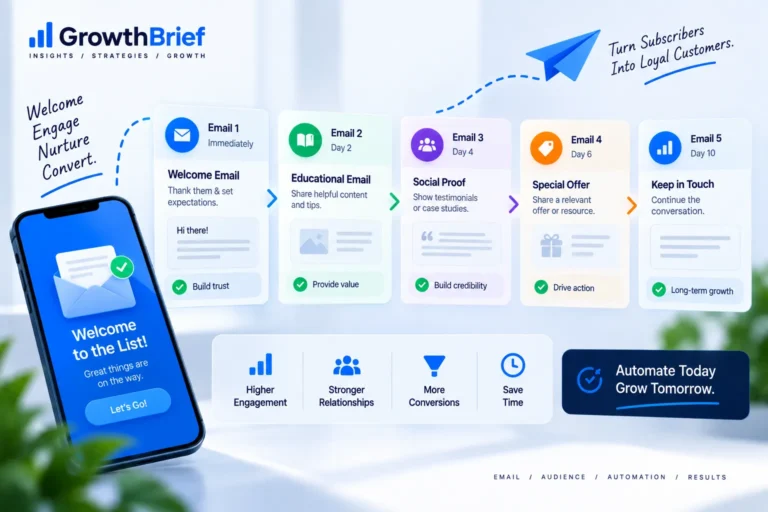
Use multiple messages when onboarding requires progressive education. Give each message a distinct job: orientation, first success, useful resources, proof or examples, then an appropriate next action.
Do not add emails merely to make the sequence longer. If you need a starting structure, use the Email Sequence Planner and then adapt the timing and message jobs to your audience.
Measure welcome performance
Track delivery, clicks on the primary action, activation or conversion, unsubscribes and replies where relevant. The sequence should be judged by whether new subscribers successfully enter the relationship.
Compare acquisition sources because subscriber intent can differ substantially.
Handoff to the regular journey
Define what happens after welcome: newsletter, customer onboarding, customer lifecycle or another automation. Prevent overlap with messages that assume a different customer state.
Map the handoff using the GrowthBrief automation framework.
Four Welcome Blueprints
| Business | First message | Useful next step |
|---|---|---|
| Publication | Confirm topic and cadence | Read a cornerstone guide |
| SaaS | Confirm account and orient user | Complete first meaningful action |
| Ecommerce | Confirm signup/offer | Browse relevant category or preferences |
| Service business | Confirm inquiry/resource | Understand next step or book when appropriate |
Example Copy Framework
Opening: “You’re subscribed—here’s what happens next.” Value: deliver the resource or explain what the subscriber will receive. Orientation: point to one strong resource or first product action. Expectation: explain cadence or process when useful. CTA: choose one action that moves the relationship forward.
Welcome-Sequence Branches
A welcome workflow can stop or change when the subscriber becomes a customer, completes onboarding, updates preferences or unsubscribes. Do not keep sending introductory education after the contact has already advanced. This is where welcome email design becomes lifecycle design rather than a static autoresponder.
Frequently Asked Questions
Should a welcome email be sent immediately?+
Usually the confirmation or promised resource should be delivered promptly, but the timing of later welcome messages should match the journey.
How many welcome emails should there be?+
As many as the onboarding need justifies. A simple publication may need one; a complex product may need a sequence.
What should a welcome email include?+
Confirm the signup, deliver anything promised, explain what the subscriber can expect and provide one useful next action.
Should welcome emails include a promotion?+
They can when it fits the signup context, but the first priority should be fulfilling the promise that caused the subscription.
When should a welcome sequence end?+
End or branch the sequence when the subscriber completes the intended onboarding step, becomes a customer, changes preferences or enters another lifecycle state.
Similar Posts
What Is Email Marketing Automation? Examples, Triggers and Workflows
Learn what email marketing automation is, how triggers, conditions and actions work, useful workflow examples, and how to build your first automation.
Email Drip Campaigns: Examples, Strategy & How to Build One
Learn how email drip campaigns work, when to use them, how to plan a sequence, and how to measure an automated nurture journey.
Abandoned Cart Emails: Examples, Templates, Subject Lines & Sequence
Use practical abandoned cart email templates, subject-line ideas, examples and a three-email recovery sequence to bring shoppers back without relying on automatic discounts.
Email Personalization: Strategies, Examples & Best Practices
Learn how to personalize email with lifecycle, behavior, preferences and customer context without creating a creepy or fragile experience.